

cc.web.local

twitter Linkedin acp Contact Us

Fertilizers & Pesticides

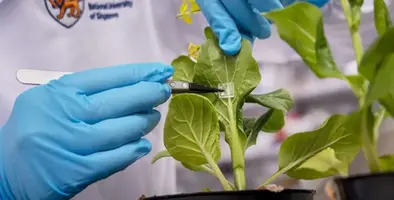
NUS develops microneedle system for faster plant growth. (Image credit: NUS)

Researchers at the National University of Singapore (NUS) have unveiled a cutting-edge microneedle biofertiliser system that could redefine sustainable agriculture and precision farming.

The innovative technology uses dissolving microneedle patches to deliver living biofertilisers directly into plant tissue, bypassing soil-related limitations and significantly improving efficiency.

In controlled greenhouse trials, leafy vegetables such as Choy Sum and Kale showed faster and healthier growth, recording higher shoot biomass, increased leaf area and greater height all while using over 15 per cent less biofertiliser compared to conventional soil inoculation. This breakthrough highlights a promising pathway to reduce fertiliser waste and minimise environmental impact.

Traditionally, biofertilisers  beneficial bacteria and fungi that enhance nutrient uptake and stress tolerance are applied to soil, where they face competition from native microbes and adverse conditions. The NUS approach sidesteps these challenges by delivering microbes straight into leaves or stems, enabling faster and more targeted results.

“Inspired by how microbes can migrate within the human body, we hypothesised that by delivering beneficial microbes directly into the plant's tissues, like a leaf or stem, they could travel to the roots and still perform their function, but much more effectively and be less vulnerable to soil conditions,” said Assistant Professor Andy Tay from the Department of Biomedical Engineering at NUS, who led the study.

The plant-friendly microneedles, made from biodegradable polyvinyl alcohol (PVA), dissolve within a minute of application, releasing their microbial payload gently into the plant. Laboratory tests confirmed minimal tissue disruption, stable chlorophyll levels and a rapid return to normal stress markers, underscoring the system’s safety and viability.

The team successfully delivered a plant growth-promoting rhizobacteria (PGPR) cocktail directly into plant tissue, outperforming soil-based treatments. Importantly, growth response correlated with microbial dosage up to an optimal threshold, allowing growers to determine the lowest effective dose and cut costs.

“Our microneedle system successfully delivered biofertiliser into Choy Sum and Kale, enhancing their growth more effectively than traditional methods while using over 15 per cent less biofertiliser,” Asst Prof Tay said. “By faster growth we refer to higher total plant weight, larger leaf area and higher plant height.”

With strong potential for urban farming, vertical farms and high-value crops, the researchers are now exploring scalability, automation and wider crop trials. This pioneering “microneedle biofertiliser” concept positions smart agri-tech at the forefront of eco-friendly, future-ready farming.
Pupuk Indonesia's commitment to sustainable industrial development.

Indonesia has entered a significant new phase in its industrial development as Pupuk Indonesia Group through its subsidiaries PT Pupuk Kalimantan Timur (Pupuk Kaltim) and PT Rekayasa Industri (Rekind) has officially launched the construction of the country’s first-ever soda ash factory.

This milestone, celebrated with a groundbreaking ceremony and the installation of the first pile at the Kaltim Industrial Estate (KIE) in Bontang, East Kalimantan, marks a major step forward for the national fertiliser and petrochemical industry.

Senior figures including the Senior Director of Business Performance & Asset Optimization at Danantara Asset Management, Bhimo Aryanto, senior leaders from Pupuk Indonesia and Pupuk Kaltim, as well as representatives from both the East Kalimantan Provincial Government and the City of Bontang, were present to witness the start of this strategic project.

Pupuk Indonesia President & Director Rahmad Pribadi described the development as a historic progression in the long-standing evolution of Indonesia’s chemical and fertiliser sectors, which date back to 1959. He emphasised that the project is not only part of strengthening the nation’s industrial self-sufficiency but also demonstrates a clear commitment to downstreaming and achieving a low-emission, sustainable industrial transformation.

He highlighted that the initiative aligns closely with the Asta Cita vision of President Prabowo Subianto and Vice President Gibran Rakabuming Raka. By utilising carbon dioxide (CO₂) generated as a by-product of existing ammonia production, the plant will manufacture soda ash—an essential input for industries such as glass, ceramics, detergent, pulp and paper, food processing, and more.

Once operational, the factory is expected to produce 300,000 metric tonnes of soda ash each year, covering roughly 30% of domestic demand and significantly reducing reliance on imports. This shift could save up to IDR 1 trillion annually in foreign exchange from soda ash alone, alongside around IDR 250 billion from ammonium chloride import substitution, another valuable by-product of the process.

Pupuk Kaltim President & Managing Director Gusrizal reinforced the importance of the project in supporting national downstreaming priorities and enhancing the resilience of Indonesia’s chemical industry. He noted that the development forms a crucial part of the company’s wider business transformation, aiming to diversify into more efficient and environmentally responsible chemical ventures.

“This project is part of Pupuk Kaltim’s commitment to implementing ESG principles and a circular economy, where CO₂ emissions from the existing plant are reused as the main raw material for soda ash production. We will ensure that the entire construction process is carried out with the highest safety and quality standards, as a manifestation of our responsibility to provide an efficient, safe, and competitive industry,” said Gusrizal.

The plant is projected to absorb around 174,000 tonnes of CO₂ annually, directly supporting Indonesia’s 2060 Net Zero Emission (NZE) target. Its circular-economy approach turns emissions into high-value products while strengthening domestic supply chains. The ammonium chloride generated can also be used as fertiliser, reinforcing national food security.

Economically, the facility is anticipated to stimulate both regional and national growth by creating jobs, empowering local MSMEs, and supporting industries involved in supplying inputs such as industrial salt.

Danantara Asset Management’s Bhimo Aryanto expressed his strong support for the initiative, emphasising its broader national significance. “Pupuk Indonesia Group continues to innovate in developing efficient, low – emission, and sustainable industries. This project not only creates an industry but also optimizes existing resources and significantly reduces industrial waste. We want this plant to become a new benchmark for Indonesia’s green chemical industry,” he said.

For Pupuk Indonesia Group, the soda ash plant signals a renewed commitment to national industrial resilience, food security, and long-term economic sovereignty. With a focus on innovation and downstream growth, the Group aims to strengthen Indonesia’s competitiveness through sustainable, future-ready industrial development.

Sumitomo Chemical aims to promote regenerative agriculture and build a more sustainable global food system. (Image credit: Sumitomo Chemical)

Japan’s Sumitomo Chemical has announced a major step towards advancing sustainable agriculture by reorganising its U.S. operations to strengthen its biorational business

The company will merge Valent BioSciences LLC (VBS), McLaughlin Gormley King Company (MGK), and Valent North America LLC (VNA) into one integrated entity. The newly formed company, Sumitomo Biorational Company LLC (SBC), will begin operations in Libertyville, Illinois, in April 2026. This hub will lead innovation in environmentally friendly farming technologies and deliver comprehensive, sustainable solutions worldwide.

Sumitomo Chemical’s Agro & Life Solutions Sector operates on two strong foundations – crop protection products and biorationals. With growing global demand for agricultural solutions that reduce environmental harm, the market for biorationals is set to expand steadily. The company aims to more than double its biorationals sales to around 150 billion yen by the 2030 financial year, compared to 2024 levels.

According to the company, “Valent BioSciences LLC (“VBS”), McLaughlin Gormley King Company (“MGK”), and Valent North America LLC (“VNA”)—Sumitomo Chemical’s U.S. subsidiaries will be integrated into the surviving company VBS, which will be renamed Sumitomo Biorational Company LLC (“SBC”). SBC will commence operations in Libertyville, Illinois, starting April 2026, as the Group’s global hub driving innovation in this field, and it will provide comprehensive and sustainable biorational solutions across the world.”

By consolidating research, manufacturing, and sales within SBC, Sumitomo Chemical aims to build a more efficient and streamlined structure. This integration is expected to enhance collaboration, reduce duplication, and strengthen the company’s position as a global leader in sustainable agricultural technologies.

SBC will serve as the central hub for the company’s innovation in biorationals, driving new advancements that support sustainable development, environmental protection, and improved agricultural productivity. Its work will span various sectors including crop health, pest management, forestry, and animal health.

Additionally, Valent USA LLC will become a wholly owned subsidiary of SBC and continue to manage crop protection product development and sales across the United States, Canada, and Mexico.

Through this reorganisation, Sumitomo Chemical aims to promote regenerative agriculture and build a more sustainable global food system. The company continues to focus on delivering unique technologies that help farmers produce healthy crops, protect the environment, and ensure long-term agricultural growth.

Magüey Green is showing that greener farming can also mean fairer opportunities.(Image credit: Magüey Green)

At Magüey Green, farming innovation goes hand in hand with social inclusion and environmental care

This forward-thinking fertiliser company has made it its mission to support both the land and the people who work it especially those with disabilities. Through sustainable agricultural solutions, Magüey Green is showing that greener farming can also mean fairer opportunities.

"The Magüey Green project was started by Miguel Ángel López, an agricultural production expert, who began developing eco-friendly products to address the issue of nitrate filtration into the Mar Menor," said Juan Antonio López García, the company's manager. "From there, the idea emerged to create a line of fertilizers that help retain water and nutrients in the soil, reducing both environmental impact and input use."

Operating from the Polígono Industrial Oeste in Alcantarilla (Murcia), Magüey Green functions as a special employment centre, offering stable jobs and training for people with functional and intellectual diversity. "We wanted these individuals to have stable employment, training, and a real opportunity for inclusion," López García added. "After presenting the project to the SEPE and obtaining authorisation, we launched this fusion of industrial activity with a social mission, which has now been running for three years."

Inside the facility, workers blend, package, and prepare the company’s signature products. Among them, Fertired stands out as a revolutionary solution for modern farmers. Designed for use in irrigation systems, it helps the soil retain water and nutrients, reducing nitrate leaching and protecting nearby water sources like the Mar Menor.

"Each molecule can retain up to 300 times its volume in water, keeping it available for the plant for about 30–40 days," López García added. "This allows us to reduce water and fertilizer use by more than 30%. In fact, trials conducted in pepper crops have shown efficiency increases of over 50% under greenhouse conditions."

Alongside Fertired, Magüey Green produces certified biofertilisers and natural fungicides that meet EU organic standards. As López García said, "Our goal is not only to improve crop efficiency but also to show that agriculture can foster inclusion and opportunity. We want every litre of product we make to carry a story of sustainability, and of people who overcome challenges every day."

A game changer for phosphate production.

Singapore-based Indorama Group, through its Senegalese subsidiary Industries Chimiques du Sénégal (ICS), has announced a significant US$210mn investment aimed at expanding and modernising its fertilizer production facilities in Senegal

This investment, outlined in a memorandum of understanding with Senegal’s Investment and Major Projects Promotion Agency (APIX), was unveiled at the Senegal Investment Forum and will be executed between 2025 and 2028.

The main focus of the programme is to strengthen Senegal’s role in the agricultural input sector by enhancing its phosphate and fertilizer production capabilities. Senegal has a growing agricultural market, and this investment aims to address key gaps in fertilizer supply, benefiting local farmers and boosting agricultural output across the region.

ICS plans to upgrade its facilities, particularly at the Mbao fertilizer plant, where it will increase production of NPK (nitrogen, phosphorus, and potassium) and DAP (diammonium phosphate) fertilizers from 250,000 to 400,000 tons annually. The company will also build a new Single Super Phosphate (SSP) unit, which will have an annual capacity of 350,000 tons. Additionally, ICS is set to ramp up phosphoric acid production at its Darou plant to 660,000 tons per year, supported by a new sulfuric acid plant capable of producing 700 tons per day. These improvements are expected to significantly boost ICS’s presence in Senegal’s fertilizer market.

Currently, Senegal relies heavily on imported fertilizers, bringing in an average of 126,484 tons annually, valued at $97.4 million between 2020 and 2024. Fertilizer use in the country is still limited, with application rates standing at just 8.5 kg per hectare in 2022. This is far below the sub-Saharan African average of 18.5 kg and the African Union’s target of 50 kg per hectare set at the 2006 Abuja Fertilizer Summit. NPK fertilizers dominate the local market, comprising 50% of usage, followed by urea (30%), DAP (7%), and potassium muriate (3%).

This investment in local fertilizer production aligns with the 2024 Nairobi Declaration, which urges African nations to triple their fertilizer production by 2034. By boosting domestic manufacturing, the initiative aims to reduce Senegal’s dependency on imports, make fertilizers more accessible to smallholder farmers, and enhance agricultural productivity.

More Articles …