Across Southeast Asia, farmers face increasingly erratic weather, shifting market demands, and tightening agricultural research budgets
To tackle these shared pressures, seven ASEAN countries have backed a regional crop-breeding network designed to fast-track the development of climate-resilient, high-yielding varieties. Supported by the International Rice Research Institute (IRRI) and the CGIAR Breeding for Tomorrow (B4T) Science Program, the proposal earned formal support during the ASEAN Agrifood Convening on 17–18 November 2026 at IRRI headquarters in Los Baños, Philippines. Representatives from the Philippines, Vietnam, Indonesia, Thailand, Myanmar, Lao PDR, and Cambodia signed an aide-mémoire endorsing the initiative and a new technical working group.
Pooling resources across Southeast Asia
Rice remains central to regional food security, whilst maize, potato, cassava, and sweet potato underpin nutrition, livestock feed, and diversified farm incomes. Opening the convening, IRRI Director General Dr Yvonne Pinto stressed that crop improvement must be directly linked to broader seed and policy frameworks.
“We therefore need an integrated approach that connects crop improvement, germplasm exchange, breeding networks, seed systems, climate resilience, and the policies and investments needed to bring innovations to scale,” she said.
With research budgets under growing strain, IRRI Research Director Dr Michael Quinn highlighted the value of combining complementary strengths across borders.
“None of us has all the resources we would like, but the region has different strengths, environments, research capabilities, and experiences that can complement one another. By sharing knowledge, pooling resources, and aligning our breeding efforts toward common goals, we can achieve more together as a region,” he said.
CGIAR Breeding for Tomorrow Partnerships Lead Dr Biswanath Das added that regional work must stay aligned with national priorities, giving domestic partners stronger roles where they hold expertise whilst reducing duplication.
Shared priorities and faster variety development
Reviewing national rice production goals through 2035, delegations identified five areas for joint action: climate-resilient varieties, modern breeding technologies, stronger seed distribution, sustainable production, and improved grain quality, postharvest systems, and market access.
To deliver new varieties faster, the network will focus on three pillars:
- Shorter breeding cycles: Sharing pipelines, accelerating plant line generation, and conducting multi-location testing.
- Capacity building: Strengthening breeding capacity, particularly in Cambodia, Lao PDR, and Myanmar.
- Seed regulation alignment: Coordinating varietal release rules so suitable seeds cross borders more smoothly.
Breeding will target tolerance to flooding, drought, salinity, and heat, plus resistance to blast, bacterial blight, and planthoppers, as well as varieties suited to low-emission, water-efficient practices such as alternate wetting and drying (AWD). Crop-breeding programmes will also address specific market preferences across the region. Priorities include high-zinc and low-glycaemic-index rice, jasmine and fragrant varieties for Thailand and Cambodia, premium export grain for Vietnam, and varieties suited to local preferences in Indonesia, the Philippines, Malaysia and Lao PDR. The programmes will later expand to root and tuber crops, as well as maize.
For Ralph Ceniza, Program Director of the Philippines’ Department of Agriculture National Rice Program (DA-NRP), regional cooperation must ultimately boost farmer incomes and stability, echoing the country’s 2031 vision.
“We recognize that no single country could address these challenges alone. Our collective expertise, resources, and diverse agricultural environments across ASEAN provide an opportunity that we must fully utilize. Let us move from shared challenges to shared solutions, and from national priorities to meaningful regional actions.”
Turning regional commitments into action
Ngoc Thach Tran, Director of the Cuu Long Delta Rice Research Institute, reaffirmed Vietnam’s readiness to help shape the network through the new working group.
“Vietnam strongly supports the establishment of a regional breeding and research network, beginning with rice and expanding collaboration to other priority crops over time. We are committed to participating in the proposed working group and supporting the development of this network to strengthen regional cooperation and deliver long-term benefits to all member countries,” he said.
Reaffirming CGIAR’s backing within its capacity, Dr Das urged partners to keep up the pace as the initiative shifts towards implementation.
“We have made significant progress in aligning our common goals and priorities. This is an important step, and we must maintain the momentum to turn these priorities into action,” he said.
ASEAN backs regional crop breeding network for climate resilience
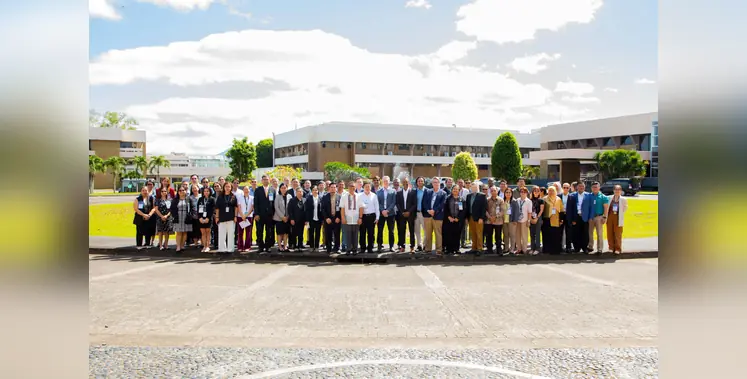
The proposal earned formal support during the ASEAN Agrifood Convening on 17–18 November 2026 at IRRI headquarters in Los Baños, Philippines.