




Researchers at the National University of Singapore (NUS) have unveiled a cutting-edge microneedle biofertiliser system that could redefine sustainable agriculture and precision farming.
The innovative technology uses dissolving microneedle patches to deliver living biofertilisers directly into plant tissue, bypassing soil-related limitations and significantly improving efficiency.
In controlled greenhouse trials, leafy vegetables such as Choy Sum and Kale showed faster and healthier growth, recording higher shoot biomass, increased leaf area and greater height all while using over 15 per cent less biofertiliser compared to conventional soil inoculation. This breakthrough highlights a promising pathway to reduce fertiliser waste and minimise environmental impact.
Traditionally, biofertilisers beneficial bacteria and fungi that enhance nutrient uptake and stress tolerance are applied to soil, where they face competition from native microbes and adverse conditions. The NUS approach sidesteps these challenges by delivering microbes straight into leaves or stems, enabling faster and more targeted results.
“Inspired by how microbes can migrate within the human body, we hypothesised that by delivering beneficial microbes directly into the plant's tissues, like a leaf or stem, they could travel to the roots and still perform their function, but much more effectively and be less vulnerable to soil conditions,” said Assistant Professor Andy Tay from the Department of Biomedical Engineering at NUS, who led the study.
The plant-friendly microneedles, made from biodegradable polyvinyl alcohol (PVA), dissolve within a minute of application, releasing their microbial payload gently into the plant. Laboratory tests confirmed minimal tissue disruption, stable chlorophyll levels and a rapid return to normal stress markers, underscoring the system’s safety and viability.
The team successfully delivered a plant growth-promoting rhizobacteria (PGPR) cocktail directly into plant tissue, outperforming soil-based treatments. Importantly, growth response correlated with microbial dosage up to an optimal threshold, allowing growers to determine the lowest effective dose and cut costs.
“Our microneedle system successfully delivered biofertiliser into Choy Sum and Kale, enhancing their growth more effectively than traditional methods while using over 15 per cent less biofertiliser,” Asst Prof Tay said. “By faster growth we refer to higher total plant weight, larger leaf area and higher plant height.”
With strong potential for urban farming, vertical farms and high-value crops, the researchers are now exploring scalability, automation and wider crop trials. This pioneering “microneedle biofertiliser” concept positions smart agri-tech at the forefront of eco-friendly, future-ready farming.
NUS develops microneedle system for faster plant growth
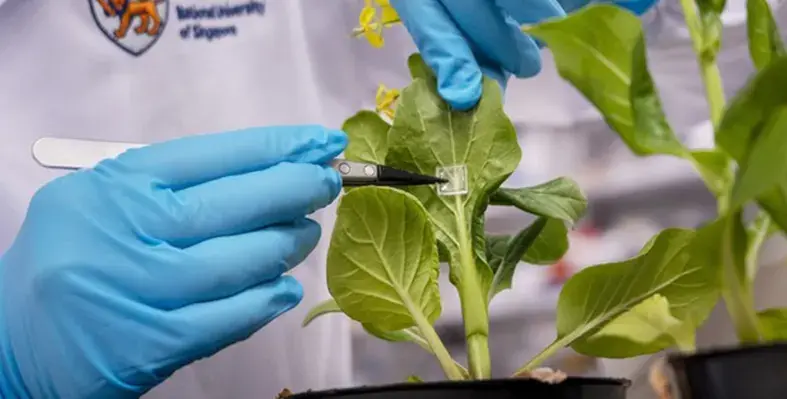
NUS develops microneedle system for faster plant growth. (Image credit: NUS)